Professional immigration in 2026: the impact of the 2026 budget

The conclusion on February 2, 2026, of the long legislative process for the 2026 Finance Bill (PLF) has provided France with a budget, but it also introduces significant changes regarding the cost of immigration procedures, particularly those related to professional immigration in France.
Administrative fees increased
One of the key measures of the 2026 Finance Bill concerns the adjustment of fiscal stamp and administrative taxes applied to residence permits, long‑stay visas, and other procedures linked to professional activity.
According to the texts that were definitively adopted, several categories of procedures will see their fees increase.
Additionally, some procedures that were previously free of charge will now incur fees.
|
Type of procedure |
Fees until 2025 |
Fees in 2026 |
Evolution |
|
Multi‑year Employee Residence Permit |
225 € |
350 € |
+125 € |
|
Talent Passport |
225 € |
350 € |
+125 € |
|
ICT Detached Employee Permit |
225 € |
350 € |
+125 € |
|
Researcher / Scientist Permit |
225 € |
350 € |
+125 € |
|
Validation of long‑stay visa (VLS‑TS) |
200 € |
300 € |
+100 € |
|
Replacement of permit (loss/theft) |
225 € |
350 € |
+125 € |
|
Provisional Residence Permit (APS) |
0 € |
100 € |
+100 € |
|
Exchange of foreign driver’s license |
0 € |
40 € |
+40 € |
|
10‑year Resident Card |
225 € |
350 € |
+125 € |
|
Fiscal stamp for a French nationality application |
55 € |
255€ |
+200 € |
These amounts correspond to stamp duties and administrative taxes.
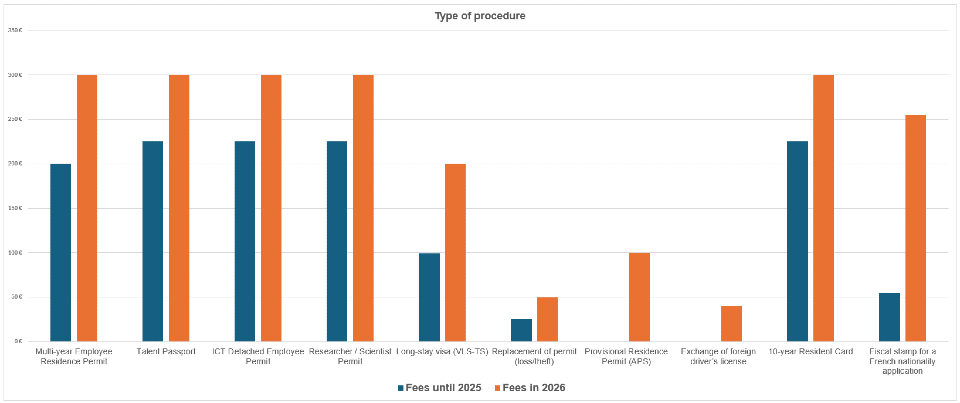
The state anticipates that these increases will generate over €150 million in additional revenue, in a context of tighter budget controls.
Constitutional validation pending
At this stage, it is important to note that the finance law for 2026 has not yet been definitively validated by the Constitutional Council, and the implementing decrees have still to be published. Certain provisions—particularly those relating to duties and taxes applied to residence permits—may still be partially struck down or subject to restrictive interpretation.
This validation will be especially important given the criticisms raised, notably by Cimade, which has already emphasized that these increases could disproportionately affect access to rights.
In this evolving regulatory context, anticipating budgets linked to securing immigration procedures becomes essential.
The Immigration Department of Home Conseil Relocation is available to support you in anticipating these impacts while ensuring a smooth and compliant employee experience.
Sources
- Le Monde – Les Décodeurs : Budget 2026 – mesures adoptées par 49.3
- Assemblée nationale – Texte adopté du PLF 2026 (provisoire)
- La Cimade – Budgets 2026 : des titres de séjour toujours plus chers (analyse critique) :
- Brut – Budget 2026 : suppression des APL, augmentation des taxes
- Infomigrants – Hausse des frais pour l’obtention d’un titre de séjour :
- ASH – Principales mesures sociales votées pour 2026 (incluant naturalisation)

