Immigration News May 2026

While the digitalization of administrative procedures was intended to simplify access to public services, the ANEF platform continues to face criticism due to persistent technical failures. Following a referral by several associations, the Council of State issued a decision on May 5, 2026, ordering the State to remedy the shortcomings affecting this now-central platform, to prevent these dysfunctions from delaying access to employment, the renewal of rights, and the securing of residency for foreign nationals, thereby hindering their integration in France.
As mentioned in our previous newsletter, this decision confirms the warnings issued by the Human Rights Defender (Défenseure des droits), who is facing an “exponential increase” in complaints related to immigration law. In her 2025 annual report, the Defender states that excessive delays and ANEF dysfunctions have placed thousands of foreigners in an irregular status, leading to the loss of rights such as job loss or the suspension of social benefits. The Human Rights Defender notes an explosion in claims regarding foreigners' rights: from 6,000 in 2019 (10% of total claims received) to over 50,000 in 2025 (41%), three-quarters of which concern residence permit renewals. These difficulties, linked to the non-issuance of provisional receipts (récépissés) or technical glitches, overload associations and courts despite repeated warnings.
Concrete issues impacting users' rights
To guarantee normal access to public services and the effective exercise of users' rights, the Council of State orders the administration to take the following actions:
Within 6 months:
- Guarantee the automatic issuance and renewal of certificates of extension of instruction (API) for residence permit holders.
- Align regulatory texts to ensure better recognition of these certificates in accessing social rights and housing.
- Allow the correction or completion of a file in the event of an error.
Within 12 months:
- Upgrade the ANEF platform to technically allow the simultaneous or successive submission of multiple residence permit applications.
In line with the Council of State: new integration priorities for 2026
In parallel with this decision, and faced with historic backlogs within prefecture services, the Minister of the Interior issued an instruction setting a strict framework with concrete measures to reduce processing times. The national objective is to bring the average processing time down to 55 days, whereas it reached 117 days, and even 120 actual days in certain prefectures in 2025.
To achieve this, the Ministry is immediately deploying budgetary, human, and regulatory resources:
- Targeted Reinforcements: The allocation of €2 million in overtime pay for file "backlog clearing" operations, and the recruitment of 500 temporary agents specifically dedicated to renewals and professional immigration.
- Prioritization and Streamlined Checks: Since the substantive review of initial applications for "Talent" or "ICT Detached Employee" permits is already conducted upstream by Consulates, the review in prefectures will be streamlined to focus solely on public order checks.
- Automation to Prevent Loss of Rights: Automated issuance of certificates of extension of instruction (API) for up to 12 months to secure the right to work, and the systematic granting of multi-year permits or resident cards as soon as substantive conditions are met, even without an express request.
- Simplification of Rules: Strict application of a reformed list of supporting documents (prefectures are strictly forbidden from requesting any others) and the permanent removal of the obligation to declare a change of address for long-term permits.
- Biometric Measure: The validity period of biometric fingerprints is immediately extended from 5 to 10 years, limiting required in-person visits to the prefecture.
Increasing backlogs at the root of the congestion
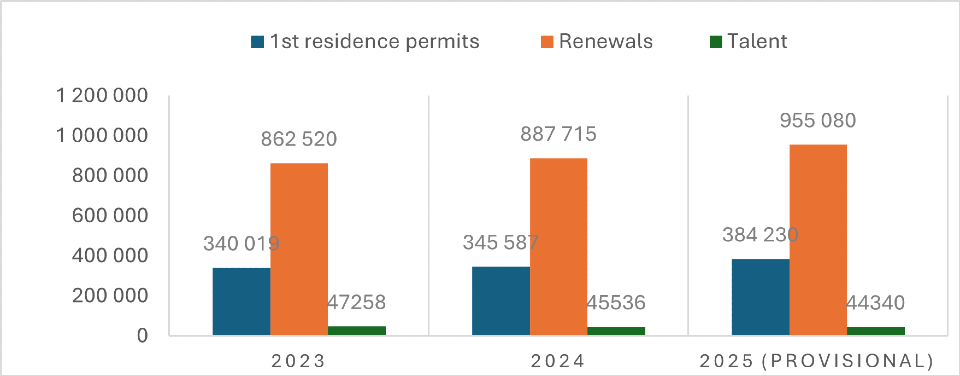
This crisis regarding processing times and the observed dysfunctions is factually explained by a structural and massive surge in the volume of files to be processed, which is saturating prefecture services. Consequently, the administration is currently facing 930,000 files awaiting instruction nationwide.
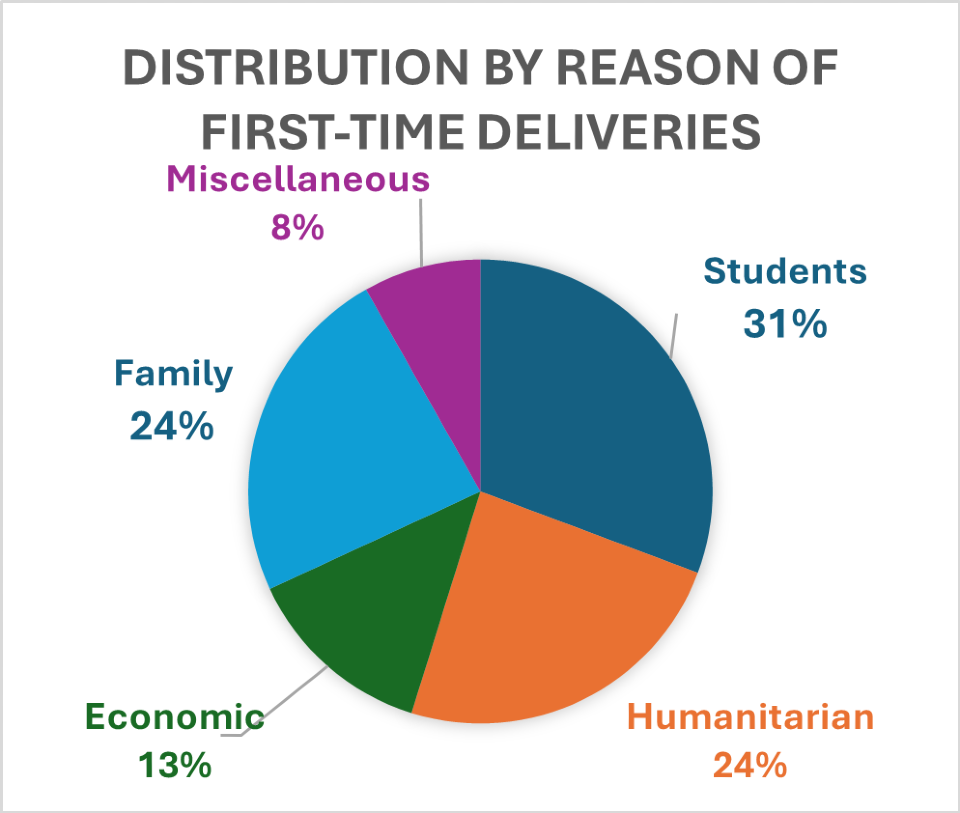
According to the official statistics published by the General Directorate for Foreign Nationals in France (DGEF) for the year 2025, activity is characterized by strong disparities:
- Initial residence permits increased overall by 11.2% and renewals by 7.6%.
- The "Student" category remains the primary reason for issuance (3 out of 10 initial permits).
- Permits issued on humanitarian grounds experienced a spectacular jump of 65%, becoming the second most common reason for initial issuance.
- Conversely, initial permits for economic reasons fell by 12.6% (a decrease for employees and seasonal workers), although "Talent" permits showed a growth of 4.4%.
- Finally, asylum applications decreased by 10.3%.
For companies, expatriate employees, and families in professional mobility, the proper functioning of ANEF directly determines the continuity of residence procedures and access to the labor market. This issue is even more important because digitalization should not weaken foreign nationals’ administrative pathways but rather secure their rights within a clear and accessible framework.
The Immigration department of Home Conseil Relocation remains available to help anticipate these developments and secure mobility procedures in a stable and compliant framework.
Sources:
- Services publics : le Conseil d’État enjoint à l’État de garantir un accès normal à la plateforme en ligne de l’ANEF - Conseil d'État
- La Défenseure des droits publie son rapport annuel pour l’année 2025 | Défenseur des Droits
- Les chiffres de l'immigration en France | Direction générale des étrangers en France
- Circular NOR: INTK2608979J (unpublished)

